
Vollbild ansehen
Tuning
v0.1
BeamNG v0.1
Alpha ACP - Angelov's Customizable Powertrains
Mod erstellt von:
@BeamNG Community
Hinzugefügt:
Vor 9 Std.
Customizable engines with realistic consequences to modifications.
mod_description
Have you ever felt that the vanilla engines seem a bit too simple? Ever wanted to be searching the web whether a Forged Steel Crankshaft is better than a Billet Aluminum one? Then this is the mod for you!
Built from the ground up with extensive research and knowledge I've accumulated in real life over the years of dealing with car repairs, tuning and combustion engines in general. Ever wanted a sim-cade engine building experience that really conveys the fact that everything in engine building is a balancing act of power, response, price and reliability? Then this is the right mod for the job.
A homage
I've spent countless hours on this passion project that was inspired by RK's engines. For me that mod was a cornerstone of BeamNG, however I've always felt it's a bit too linear, with no real drawbacks to picking one part over another. So I decided to spend an unhealthy amount of time building a more realistic way to modify engines, with some extra fancy features like rolling launch control on top. Please do check out RK's mod as well!
RK's Highly Customizable Engines
Current status: Early Alpha. Currently available ONLY for the old Ibishu Pessima, additional vehicles planned once all engine families are available for the Pessima. V6, V8, V10, V12 and V16 due to be added.
Short overview
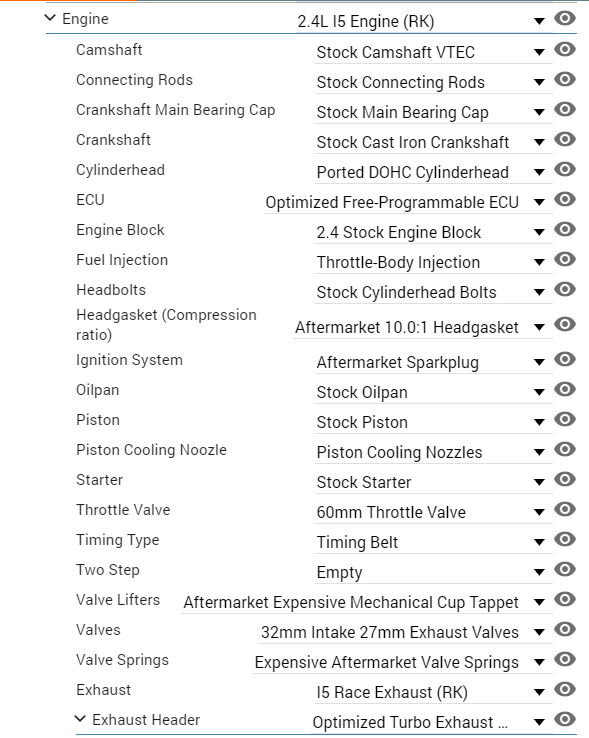
This is a mod for building your own engine configuration and customizing it to its potential, built from the ground up with realistic component compromises and career pricing in mind. Each component changes how the engine reacts. No stat sticks to bonk the engine, no "Stage +10 power" parts. You want a high revving engine? You better be ready to sacrifice torque!
All the parts uniquely shape the engine's parameters to their real-life equivalents then are fed through BeamNG's own simulation LUAs with some slight tweaks and layering, providing a surprisingly in-depth engine building experience! Think of this less of a customizable engines mod and more of a modular engines mod.
This is a finished working Alpha, however - Changes are expected, feedback is always welcome. If you feel something is off-balance or unrealistic, please let me know, it's my first time making a mod so there might be some less-than-ideal situations that may pop up between all the combinations and permutations of parts. While realism and career focused, it's not yet finished, use in BeamNG career at your own risk
Mapped overview:
4 engine families: I3, I4, I5 and I6, each with its own hand authored torque curve, redline, inertia, friction model, burn efficiency, oil capacity and internal coolant capacity.
53 displacements per family: 0.6L all the way to an 18.0L monster.
Valvetrain & heads: 9 head types (OHV / SOHC / DOHC in stock, street ported and race ported form), 6 camshafts, 7 compression ratios, 7 valve sizes, 9 valve spring tiers.
Complete bottom end: 8 rod types, 8 piston types, 6 crankshafts, 4 bearing tiers, 4 block materials, 6 flywheels, 5 starters, 5 oil pans including dry sump.
Forced induction: 5 turbo architectures with 9 sub-slots each, 14 turbine wheel sizes, 3 supercharger types with pulleys, rotors, bearings and clutches.
Electronics: 7 ECUs, 3 rev limiter styles, 7 launch control variants including rolling and adaptive rolling launch, 4 safety controllers.
Breathing: 5 fuel types, 10 fuel delivery systems, 8 intake manifolds, 14 throttle bodies, 5 air filters, NA and turbo headers.
Lightweight build: close to 500 parts, only a few hundred kilobytes, because every single sound is pulled from the game's own sound bank. No audio files shipped.
Mostly BeamNG career ready: every part has a real price not a random number.
Detailed overview of almost the parts and their effects
Below is a map of what each slot actually touches, it would be extremely long and boring to explain each part individually in grueling detail so treat this as a cheat sheet and you can find out the rest when you throw a rod or two
Air Filter - Stock paper is the baseline. Panel, cone and ram air boxes add a small additive airflow curve and un-muffle the intake sound progressively. No filter adds the airflow curve plus a small operational tolerance bonus, and the intake is fully unmuffled. You get what you pay for at idle.
Block Material - Sets the structural housing and the melting point (aluminum ~660°C, iron ~1100°C) and multiplies how much sustained over-torque abuse the block absorbs before letting go. Cast aluminum (stock) < cast iron < billet aluminum (2.4x) < billet steel (3.5x). Does NOT change the engine's torque rating - that is the rotating assembly's job.
Camshaft - RPM indexed multiplier curve plus idle roughness. Stock through drag. The drag cam loses ~20% below 3000 RPM and gains ~45% at 8000, with an idle which would make cammed C6s blush. Cams move the power band, they don't always add flat power.
Compression Ratio - From Low to Extreme. Touches the torque multiplier (stronger effect below 1500 RPM), burn efficiency (fuel economy and heat), engine braking, and the structural tolerance to cylinder pressure. High compression = great easy NA power and efficiency but it grenades under big boost. Low compression = lazy NA manners but eats boost all day. This is the core boost-vs-NA decision.
Connecting Rods - Torque rating, rod damage threshold and inertia. Cast iron -> powdered metal -> forged I-beam -> forged H-beam -> billet steel -> billet forged steel -> titanium (lighter but less strong, an RPM choice not a boost choice) -> titanium aluminide (lightest, most brittle, for engines that live above 10k).
Cooling System - Multiplies the radiator's heat rejection: stock, sport +30%, race +75%, endurance +125%. Doesn't change coolant volume, it changes how fast heat leaves. This is one of the parts that is in-fact a simple multiplier of cooling, however if you're playing career you'll find out it doesn't come cheap! (Note this was done to make extremely high HP builds even possible without custom radiators per-car)
Crankshaft - Torque rating, inertia, friction and a small max RPM contribution. Cast iron through lightweight billet steel. Some options add friction to account for weight others are light and rev fast!
Crankshaft & Rod Bearings - Torque rating and friction (upgraded tiers also add a little max RPM). Stock bi-metal -> performance tri-metal -> race tri-metal -> heavy duty DLC coated race tri-metal. Less friction means less parasitic loss (especially prominent the higher the RPM) and less heat.
Engine Displacement - The big one. Every displacement ships its own torque curve and rescales inertia, max RPM of the engine, friction, dynamic friction, engine braking, torque rating, all durability thresholds, oil volume and internal coolant capacity. Small engines rev fast, cool easily and can't hold big power. Big engines carry more oil and coolant mass, tolerate more torque, rev slower and run lower redlines. An 0.6L with a huge turbo is a joke that breaks. An 18.0L is a joke that breaks the car instead.
ECU - The gatekeeper. No ECU = no limiter, no protections, raw and dumb, yet surprisingly makes some power. Factory = fixed limiter, no tuning. Stage 1 adds coolant overheat protection and mild efficiency/torque changes. Stage 2 adds the fan override and launch control slots. Stage 3 adds oil temperature protection. Standalone adds oil pressure and over-torque protection plus the rev limiter type slot and real tuning sliders (idle, afterfire, engine braking). Fully Customizable is intended as a creative item costing 999,999 to avoid people using it in career it adds real engine base modifiers friction, inertia and burn efficiency overrides on top. Cheaper ECU = exposed, pricier ECU = protected. That's the progression on purpose.
ECU - Afterfire Sound - 7 profiles (I3, I4, I5, I6, V6, V8 crossplane, V8 muffled, flat 4 family). Sets the overrun pop, sustained afterfire and shift pop sound events.
ECU - Radiator Fan Override - On Ignition Always On - Any time ignition is on, fan is on useful for drag builds, Override Ignition Always On - always on, regardless of ignition state, and Override Ignition Heat Only - this one keeps the fan spinning after you kill the engine until temperatures are safe.
ECU - Launch Control - 7 variants, see the usage section below.
ECU - Engine Overheat Protection - Soft ignition cut above a tunable coolant shutdown temp (default 125°C, 100-130 range).
ECU - Oil Pressure Protection - Watches the oil lubrication and cuts ignition when it degrades past a tunable coefficient (default 0.875). Starving a corner at 1.2G with a stock pan will trigger this. Also useful for heavier off-road / crawler builds when other vehicles are added to the list.
ECU - Oil Overheat Protection - Soft ignition cut above a tunable oil temp (default 145°C, 80-250 range).
ECU - Over-torque Protection - Semi hard cut. When combustion torque exceeds the engine's structural rating times a tunable safety coefficient (Default 0.9, meaning 90% of engine's torque capability before damage, pushing this past 1.0 will allow you to exceed the engine's maximum structural limits but maintain that for too long and it will grenade), it drops you to a limp throttle limit (default 20%) that persists until you cycle the ignition. It forces you to notice.
ECU - Rev Limiter Type - Time based (hard cut with tunable cut time), soft (smooth overshoot), and RPM drop (bounces down a tunable amount). RPM limit itself is tunable 800-16000.
Exhaust Headers (NA) - Log, tubular, long tube, race equal length. Additive torque curves; long tubes and equal length trade some low end for mid and top end pull.
Exhaust Headers (Turbo) - Log, tubular and race equal length turbo manifolds. Same additive behavior, and these are what open the turbocharger slot.
Turbochargers - Single (balanced), Twin (faster spool, strong mid), Compound (fast low end plus enormous top end), Diesel Single (instant spool, chokes past 5-6k), Diesel Compound (low end response without giving up the mid). Each opens 9 sub-slots:
• Bearings (7): journal -> ball -> ceramic tiers, friction and spool speed.
• Compressor wheels (5): inertia tiers, billet/race add a little friction.
• Turbine wheels (14): 26mm to 115mm plus a custom. This is effectively your turbo size, and each wheel carries a power gamma value that shapes the spool curve. A 115mm is dead below 4000 RPM and an absolute savage after. This of course - scales with your engine displacement!
• Exhaust housings (6): backpressure, with variable geometry options for the fast-spool flavored builds.
• Oil lines (8): the turbo's heat tolerance. Water cooled tiers for race use, plus a non-career - costing 999,999 - extreme tier for people who hate physics.
Intercoolers (6): running none is cheap gives a heat soak penalty that bites past ~3500 RPM plus a reliability penalty. Bar & plate tiers remove the penalty and provide benefits progressively.
• Wastegates (14): fixed springs 0.5 to 3.0 bar, adjustable bar or psi controllers, and • Boost-By-Gear in bar or psi with a gear selector sub-part (1 to 16 gears). Gears past your selected count run at the last gear's boost, so the top selected gear is your ceiling.
• BOV and turbo sounds: 20 BOV types including no BOV, 11 turbo sound types plus a custom type with separate hiss and whine slots, and stock/increased/tunable volume tiers for everything.
Superchargers - Roots (instant boost, loud whine, runs hot), Twin-Screw (more efficient, premium), Centrifugal (behaves like a turbo, peak boost near redline, uses turbo style spool sounds so it actually sounds right). Sub-slots: 15 pulley ratios (0.25 to 4.0), lobe/screw rotor profiles, 5 bearing tiers (parasitic crank loss), direct drive or tunable electromagnetic clutch, and whine/spool sound types with volume tiers.
Flywheel - Inertia and idle smoothness. Ultra light to super heavy. See known issues.
Fuel System - 10 options from a single barrel carb to performance direct injection. Touches burn efficiency, idle roughness, charge cooling headroom and an additive airflow curve. Race carbs win at 8000 RPM on a drag build and make the car undriveable at idle. Dual port injection lets you make stupid power and still sit in traffic. Direct Injection wins on efficiency and thermal headroom but gives up a little peak airflow.
Fuel Type - 95, 98, 100 octane race gas, E85 and methanol (M100). Better fuel buys power and headroom as well as cylinder wall temperature bonus, at the cost of burning more of it. Contrary to real life E85 and Methanol will make the engine run hotter. (Side effect of BeamNG's efficiency script, possibly will fix at some point™)
Head Type - The architectural decision. OHV = low end torque, poor top end, lightest, lowest redline. SOHC = the balanced baseline. DOHC = top end breathing, heaviest valvetrain, highest redline. Porting improves airflow at the cost of idle quality and low end air velocity. Touches the torque multiplier curve, inertia, max RPM, idle roughness and engine braking.
Intake Manifold - Additive torque curves. Long runners = low-mid hump, short runners = mid-top, variable length = compromise between the two.
Oil Cooler - 4 tiers setting oil radiator area, effectiveness and thermostat opening temperature. Cheaper tiers engage later and shed less heat. This is an engine-only change and doesn't affect the visual oil cooler as thats per-car specific.
Oil Pan - Stock, bigger (+capacity, +tolerance), baffled (+pressure under load), race baffled, and dry sump (ends oil starvation entirely, reduces parasitic friction, power tolerance bonus). The stock pan will uncover the pickup in a hard corner and the oil pressure protection will let you know about it.
Pistons - Torque rating, ring damage threshold, inertia and friction. Cast aluminum through forged steel, plus low friction aluminum for NA throttle response and a indestructible tier priced at 999,999 for people who just want to avoid building the engine internals but get 4 digit consequenceless amount of power.
Starter - Cranking torque, start rate, RPM overshoot and throttle kill time. High torque for big or high compression engines, race starters fire instantly, heavy duty will crank anything.
Throttle Body - 11 gasoline options including 3 ITB tiers (additive airflow curves, ITBs sharpen response and hurt low end), plus 3 diesel anti-shudder valve variants that trade engine braking for airflow. Unfortunately, diesel variants need diesel engines, which i've not gotten around to... yet.
Valve Size - Multiplicative shape curve. Undersized valves strangle the top end but boost low end, oversized valves help the top end at a small low end cost.
Valve Springs - Pure valvetrain RPM ceiling. 9 tiers from stock to Maximum Attack. If your cam, head and engine can breathe but the valves float, this is the part.
Water Tank Reservoir - Multiplies the engine side coolant volume. More thermal mass = slower to overheat, slower to warm up, slower to cool down.
Engine Sound - Per family sound packs (I3 x5, I4 x5, I5 x4, I6 x5) swapping the engine and exhaust sound configs.
Engine Visuals - NA SOHC/DOHC and Turbo SOHC/DOHC flexbodies for the Pessima, plus a placeholder slot for custom models later™.
Cat-Back Exhaust - The vanilla Pessima exhaust slot is kept for native integration. Muffling and afterfire character interact with it like stock.
Detailed systems breakdown, for anyone interested
Engine block differentiation
The I3, I4, I5 and I6 are distinct structural designs, not reskins. Each family has its own base torque curve, redline, rotating mass, friction model, burn efficiency curve, oil volume and internal coolant capacity, and those numbers were gathered from all in-game samples and considered based on the engine's era, market and implementation then are fed to the thermal model directly. An iron I6 with 5.5L of oil absorbs and sheds heat completely differently than an aluminum I4 with 4.5L. Block selection impacts thermal behavior, oil starvation thresholds under G, and throttle response.
Engine displacements
Each of the 53 displacements per family carries its own tradeoffs. The scaling is not a flat multiplier: inertia, redline, friction, durability, torque rating, oil volume and coolant capacity each follow their own curve off the 2.0L baseline, and every torque curve is hand authored. Small engines can't hold or make a lot of power but rev fast and cool easily. Big engines shrug off torque that would grenade a small block, carry more oil and coolant, and rev like a ship engine.
Torque shaping layers
Custom Lua recalculates the engine's torque curve at spawn by stacking RPM indexed curves from every installed component. Heads, camshafts, compression, valve sizes and intercoolers apply multiplicative curves that change with RPM, so some combinations give you huge low end at the cost of top end, redline, or both. Intakes, exhausts and fuel systems apply additive curves on top: long runner manifolds shift power into the low-mid range, single plane intakes trade low end for high RPM pull, race cams trade idle stability for top end. The engine behaves like its parts list. A build with lightweight aluminum internals may not hold much power, but it will rev faster than the UI can update.
Boost tolerance & mechanical stress
Structural limits come from the weakest link in the rotating assembly: rods, pistons, crank, bearings and block. And that's not the whole story - too much torque at the wrong RPM will almost always break things, much like real life. Higher compression yields more power and efficiency naturally aspirated, but reduces peak combustion pressure tolerance, so high boost on high compression accumulates structural damage rapidly. That is used to kinda simulate the knock in overboosted / overtorqued engines.
Custom thermal simulation
The thermal model bypasses the base game's coolant capacity is replaced with a customized framework of it. Block capacity, radiator volume and coolant reservoirs add up concurrently instead of overwriting each other. As the base-game radiators overide your coolant capacity, engine block coolant capacity, radiator, expansion tank are all now seperate entities. Pan selection oil cooler tier and dry sump integration set your oil starvation risk under G. The radiator fan supports ignition linked or heat linked modes, including a post-shutdown dissipation cycle that runs until temps are safe.
Forced induction dynamics
Turbine sizing sets the boost threshold and each turbine carries a power gamma value that shapes the spool curve, so a 115mm genuinely behaves more like a big single. Compressor wheels add rotational inertia, housings change backpressure (variable geometry included), bearings change the turbo's friction and boost loss. Wastegates cover fixed springs, adjustable bar/psi, and boost-by-gear traction maps. Skipping the intercooler introduces a heat soak penalty from mid RPM up. Superchargers model pulley ratio, rotor profile, clutch engagement and parasitic crank loss all similar to the base-game's superchargers just with exposed options.
Launch control & electronics, how to use
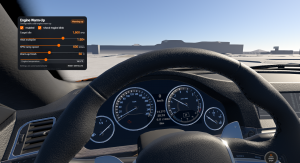
Static launch: pick a time based or RPM drop variant, set your launch RPM (and cut time or drop), hold the brake, floor the throttle and when ready to launch simply release the brake. The two-step holds RPM and the overboost variable keeps boost in the system while armed.
Rolling launch: Set a target speed and tolerance once you reach within range the systme will be ready for arming, tapping the handbrake ready will transition to armed. While armed, the car holds that speed using brake priority with a capped throttle, building boost as you roll.
Adaptive rolling launch: same as rolling, but tap the handbrake and the target snaps to your current road speed in 5, 10 or 20 km/h steps adjustable by the tuning menu, so you don't have to dial a number in between runs.
All variants expose afterfire intensity/volume so the two-step pops as much as you dare. Volumes are capped fairly low to prevent gain over-saturation.
Sound design & career integration
Every engine note, induction sound, blow-off event and supercharger whine maps to native game sound events, which is why the download is microscopic. While native sounds are used they're all customized a little bit to give unique sounds. Every part ships with a price for the parts browser and career mode, i've also prepared descriptions for the parts but that's not natively integrated yet, can be provided / added to this list later on.
Final notes
• Prices right now are semi-accurate and do NOT reflect the final version.
Currently the only visuals available are the built-in Pessima ones. This will be reworked at some point, hopefully.
• Please report any issues to the thread.
Known issues
• Manual transmissions in game already have a flywheel. Having two flywheels is not realistic, however I'm still deciding what to rename the flywheel part to so it stays realistic while still changing how fast the engine revs.
• The vanilla boost gauge rounds its scale up to the next whole unit, so adjustable/boost-by-gear wastegates can make the gauge face read one unit higher than your actual target. The boost itself is correct, only the printed scale is cosmetic.
• Some dropdowns sort alphabetically by name, so e.g. the 105mm and 115mm turbine wheels list before the smaller ones. Cosmetic, but slightly annoying.
Wie installiere ich diesen Mod in BeamNG.drive?
- Lade die Alpha ACP - Angelov's Customizable Powertrains.zip.
-
Verschiebe die .zip-Datei unverändert in deinen BeamNG Mods-Ordner:
- Starte BeamNG.drive – der Mod ist sofort im Fahrzeugmenü oder Repository aktiv!
Dateiname:
Alpha ACP - Angelov's Customizable Powertrains.zip
Dateigröße:
939 KB
Erstellt von:
@BeamNG Community
Downloads:
0
Likes:
0
Hinzugefügt am:
2.9.2026
100% virengeprüfter & kostenloser Direkt-Download
Ähnliche Mods aus Tuning
1 / 1